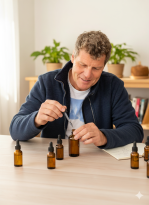
Content 50 ml
Recommended treatment
Free shipping on orders of more than € 30.00
VAT included

Do you ever wonder if your care and kindness towards other people are just you being helpful to the people you love, or whether your relationship might actually be codependent? Take our quiz to find out!
The best way to think of codependency is as a supportive relationship that's become so intense that it's unhealthy. The term codependent is often used in counselling for substance abuse, but it's also applied when describing other relationships.
There's a fine line between the natural human instinct to care for others and a relationship that has become codependent. A codependent relationship is not truly fulfilling for either partner. Because it leaves you with no time or space for yourself, codependency will eventually damage your self-esteem and leave you emotionally exhausted.
Answer Yes or No to the following questions to see whether you're codependent.
How many questions did you answer with "Yes?" A score of five or more may indicate that you are tending towards codependency. But once you've identified that there may be a problem, you can take the first steps towards a happier life.
Codependency is often linked to low self-esteem. If your self-belief is linked to the extent to which you care for others, it can be challenging to learn to value yourself in a way that doesn't depend on your personal relationships.
But valuing yourself more will boost your happiness, self-esteem and confidence. You will then find it easier to set boundaries and express your needs, two keys to escaping codependency.
Increasing your sense of self-worth will take time. These tips will help get you started:
Sources:
https://www.psychologytoday.com/gb/blog/conquering-codependency/202010/how-conquer-codependency
https://www.healthline.com/health/how-to-stop-being-codependent#value-yourself
Created by Tom Vermeersch

Tom Vermeersch is a certified Psychologist and Bach flower expert with more than 30 years of experience.

Dealing with British Summer Time
Some people are overly sensitive to the time change and it can take days, if not weeks, for them to feel right again, while others barely even notice.

12 easy ways to get people to like you
Have you ever noticed that some people are instantly likeable? Many people believe that people will only like you because of natural traits you're born with: good looks, talent and sociability. But this is a misconception. Getting people to like you is within your control, and it's all to do with self-belief, knowing yourself and being emotionally intelligent. Here's what to do to be more likeable.

5 Signs of narcissistic perversion
Narcissism is a term we often see these days. But what does it mean? It's used to describe a person who is full of themselves or overly vain. However, it's not really about self-love.

Do you suffer from a disorder known as "musturbation"? This term was first coined in the 1950s by psychotherapist Albert Ellis and described the way a negative inner voice rules our minds and bludgeons us with words such as "must", "should", and "ought".

Signs you're slipping into a burn-out
Learn how to recognise the signs of stress and avoid slipping into a burnout or a bore-out

Feel like everyone takes you for granted? Whether it's working late to prepare a presentation or cooking a special birthday meal for your partner, it's nice to be appreciated when you've made an extra effort. And if it seems as if people don't notice, you might feel as if no one values you.

Sometimes it’s hard to notice when we've become trapped in familiar routines. Take our quiz to find out if you’re stuck in a rut and what you can do about it.

Standing Up To A Narcissistic Pervert
Whether it's with a romantic partner or a housemate, there's no doubt that a relationship with a narcissist can be very challenging. But are there ways to cope better? Or is it better to leave the relationship?

Letting go of the past: 5 tips
Lynn Anderson told it very nicely in her song “I beg your pardon; I never promised you a rose garden”. Life isn’t all roses and everybody experiences something they would rather not once in their life.

Can we learn from our mistakes and develop a stronger, healthier emotional bondwith our kids? To help you identify your weak spots, we’ve rounded up some of the most common mistakes parents make.
Do you ever wonder if your care and kindness towards other people are just you being helpful to the people you love, or whether your relationship might actually be codependent? Take our quiz to find out!
The best way to think of codependency is as a supportive relationship that's become so intense that it's unhealthy. The term codependent is often used in counselling for substance abuse, but it's also applied when describing other relationships.
There's a fine line between the natural human instinct to care for others and a relationship that has become codependent. A codependent relationship is not truly fulfilling for either partner. Because it leaves you with no time or space for yourself, codependency will eventually damage your self-esteem and leave you emotionally exhausted.

Answer Yes or No to the following questions to see whether you're codependent.
How many questions did you answer with "Yes?" A score of five or more may indicate that you are tending towards codependency. But once you've identified that there may be a problem, you can take the first steps towards a happier life.
Codependency is often linked to low self-esteem. If your self-belief is linked to the extent to which you care for others, it can be challenging to learn to value yourself in a way that doesn't depend on your personal relationships.
But valuing yourself more will boost your happiness, self-esteem and confidence. You will then find it easier to set boundaries and express your needs, two keys to escaping codependency.
Increasing your sense of self-worth will take time. These tips will help get you started:
Sources:
https://www.psychologytoday.com/gb/blog/conquering-codependency/202010/how-conquer-codependency
https://www.healthline.com/health/how-to-stop-being-codependent#value-yourself
Some people are overly sensitive to the time change and it can take days, if not weeks, for them to feel right again, while others barely even notice.
Read the complete article
Have you ever noticed that some people are instantly likeable? Many people believe that people will only like you because of natural traits you're born with: good looks, talent and sociability. But this is a misconception. Getting people to like you is within your control, and it's all to do with self-belief, knowing yourself and being emotionally intelligent. Here's what to do to be more likeable.
Narcissism is a term we often see these days. But what does it mean? It's used to describe a person who is full of themselves or overly vain. However, it's not really about self-love.
Do you suffer from a disorder known as "musturbation"? This term was first coined in the 1950s by psychotherapist Albert Ellis and described the way a negative inner voice rules our minds and bludgeons us with words such as "must", "should", and "ought".
Learn how to recognise the signs of stress and avoid slipping into a burnout or a bore-out
Feel like everyone takes you for granted? Whether it's working late to prepare a presentation or cooking a special birthday meal for your partner, it's nice to be appreciated when you've made an extra effort. And if it seems as if people don't notice, you might feel as if no one values you.
Read the complete article
Sometimes it’s hard to notice when we've become trapped in familiar routines. Take our quiz to find out if you’re stuck in a rut and what you can do about it.
Read the complete article
Whether it's with a romantic partner or a housemate, there's no doubt that a relationship with a narcissist can be very challenging. But are there ways to cope better? Or is it better to leave the relationship?
Lynn Anderson told it very nicely in her song “I beg your pardon; I never promised you a rose garden”. Life isn’t all roses and everybody experiences something they would rather not once in their life.
Read the complete article
Can we learn from our mistakes and develop a stronger, healthier emotional bondwith our kids? To help you identify your weak spots, we’ve rounded up some of the most common mistakes parents make.
Bach Flowers are not medicinal but harmless plant extracts which are used to support health.
© 2025 Mariepure - Webdesign Publi4u

Are you unsure which Bach flowers can help you? Contact Tom for free advice.